Friday, 15 May 2015

Eighty Mile Beach (By Simon)

Initially we had planned to stop at Eighty Mile Beach for a short 1 or 2 day stop-over on the long drive to Broome but after just 1 day we decided to extend and stayed for 4 days. The camp site was 13km off the highway down a dirt road and was situated just behind the sand dunes with grassed camp sites and plenty of large trees (including Liz's new favourite tree... Frangipani's) for shade.


For a young family there are two main activities at Eighty Mile Beach... fishing and shell collecting  although it seems the Grey Nomads who make up 99% of the tenants indulge in a few others like talking, sleeping and more talking! You may ask why swimming is not on the list at such a beautiful beach and the reason is sharks and sea snakes of which we saw plenty!

Anyway, our family loves both fishing and shell collecting although based on the take home results we are a lot better at the latter!

Fishing was best in the afternoon so our mornings were spent driving up the beach stopping numerous times to inspect and collect shells.


The shells were spectacular and stretched up and down the beach for miles. In addition to shells we came across dozens of cone shaped sponges which doubled as hats!


We met another young family from Victoria who joined us driving on the beach and introduced us to Mud Crabs... yum!


While driving on the beach Nath took the opportunity to take a driving lesson.


Afternoons were spent fishing. As mentioned we are not the best fishermen but you can't help but enjoy it in a location like this.


We ended up catching four Blue Thredfin Salmon (kept one) and a one shark which Liz caught with her bare hands!! As it happens we were fishing and all of a sudden a 1/2 metre shark flew out of the water and lay thrashing on the beach. Liz and the kids ran up the beach and Liz picked it up by the tail and there you have it... dinner! Talking to some other fisherman they think it may have been chased into the shallows by some bigger sharks.


Time seemed to stand still at Eighty Mile Beach as our time there seemed longer than 4 days. On leaving we all felt very relaxed and blessed to have stayed at such a wonderful place.

Thursday, 14 May 2015

Point Samson, Port Hedland and Pardoo Station (By Simon)

After travelling the long days from Tom Price we were looking forward to a couple of quiet days and Point Samson was certainly quiet.

Being early in the season the camp ground was virtually empty and we enjoyed the quiet and sunshine. We met another family from Newman with two young boys so the kids had a ball at the play ground and on the blow up water slides.

We did make an effort to explore the rest of Point Samson but there is really nothing to it... a small sandy beach (at which we were attacked by sand flies), a general store, small boat harbour and 2 caravan parks.


Leaving Point Samson we called past Port Lambert. This is the final stop for the Rio Tinto iron ore trains and where the ore is loaded onto ships.


We then travelled toward Port Hedland and stopped early in the afternoon at a free camp on the Yule River. After setting up the camper we all took a walk down to the river for a refreshing swim and the kids worked their hardest to get the road trains to blow their horns!


The day ended with our little camp site bathed in orange... another glorious sunset!


We were up early the next morning heading for Port Hedland were we had a zipper fixed on the front of the camper (it had failed in the dust on the road from Tom Price). We had lunch overlooking the port which was very busy loading ships with iron ore (from the BHP mines) and saw three fully laden ships being escorted out of the port by 3 or 4 tugs.


After lunch we headed out of town to our next stop at Pardoo Station. Pardoo station is a working cattle station covering 2023 square kilometres and running about 7000 head of Santa Gertudis and Brahman cattle (we even had one greet us on the road in).


After setting up camp we went for a drive through the paddocks past a lot of cows (and a couple of huge bulls) and onto the river and then the beach. Apparently there is great fishing in the Pardoo River but none of us felt game to fish in the fading light after a large Crocodile had been spotted just days prior.


The next day was Mother's Day! The kids had a great time presenting the cards they had made, the girls sang a mother's day song they had written and played "hot & cold" with Mum trying to find her present hidden in the camper. We then cooked Mum breakfast (smoked salmon and a poached egg on toast).

By mid day we had packed up and were on our way to our next stop, 80 Mile Beach.


Travel Log:
Point Samson to 80 Mile Beach: 580 km
Total Trip: 8458 km

Sunday, 10 May 2015

Rio Tinto Rail Access Road to Millstream-Chichester National Park and Dampier (By Simon)

We had an early start as we were driving the ~240km to Millstream-Chichester National Park via the Rio Tinto rail access road. This is an unsealed private road which follows Rio Tinto's rail network from the Tom Price mine to the ports in Dampier. To travel this road we had to watch a 20 minute safety video and obtain a permit.

The trip was fantastic, passing through some spectacular country, a couple of water crossings and more that 20 iron ore trains. These are a sight to behold and we stopped every time we saw one.


Here is some facts on the Rio Tinto rail network:
- Largest privately owned and operated rail system in Australia.
- Trains are 2.5km long and consist approx. 234 wagons.
- Pulled by 3 to 4 General Electric Locomotives each generating 4500hp.
- 27,376 tonne of iron ore per train worth approximately $3.5 million.
- Trains do 60kph loaded and 80kph empty on the return journey.
- The train drivers need to press a button every 50 seconds to confirm they are still alert.
- Trains run 24 hours per day, 7 days per week.
- If a train happens to derail / crash, it is quicker to build a track around the crash site rather than clean the original (time is money in the iron ore business).

The road was very well maintained with some river crossings, minor corrugations and only a few small wash-outs to navigate around but the camper did see a lot of red dust and flying stones. The camper A-frame and underside look as if they have been sand blasted!


Late in the day we only had the Fortescue river to cross before reaching Millstream National Park. As we approached the river we saw the river was very swollen and the river crossing about 500 metres wide. My brave wife volunteered to wade across to check the depth which I am very glad she did! Most of the crossing was about knee deep but toward the end the road dropped away to be over 1 metre deep and flowing fast.


Not being able to cross with the camper in tow we tried a second entrance further down stream but this too was impassible. So we were left to camp beside the road only a couple of kilometres from our intended destination. It was, however, a glorious night with not a breath of wind, a spectacular sun set followed by a full moon and full assembly of stars!


The next morning we checked the river crossing again but the water level had only dropped 100mm. A little disappointed we left Millstream, stopping to climb Mount Herbert, heading for Python Pool, a permanent water hole about 30km north where we had lunch and a swim.


From Python Pool we got back on the sealed road and finished the remaining 100km to Dampier and then Karratha.

At Dampier we dropped in at the Red Dog statue and then drove around the ports where the iron ore is loaded onto ships bound for China, India, Japan and Korea.


As the sun started sinking we headed for Point Samson for our next stop.

Travel Log:
Tom Price to Point Samson: 482 km
Total Trip: 7882 km

Karijini National Park (By Simon)

WARNING: This blog contains pictures of snakes (that's for you Chris C!!)

As we arrived in Karijini National Park the clouds trailing off Tropical Cyclone Quang started to roll in and we were expecting rain at any minute. Regardless, we set up camp and went for a hike along the top of Dales Gorge and then down to Fortescue Falls and onto Fern pool. A great hike and both very beautiful water falls and natural pools.


Overnight we had 20mm of rain and awoke to a lot of red mud!


By 10:30am the rain had slowed and we set off on a another hike, again to Fortescue Falls but this time returning along the floor of Dales Gorge to Circular Pool. The hike was a lot more challenging, crossing the creek quite a few times requiring us to remove our boots and go bare foot.


Arriving at Circular Pool we were greeted by a crystal clear pool set at the base of 60m cliffs with a water fall at one end. We all plunged in. Given the towering cliffs shade the pool most of the day the water was quite cool but very refreshing.


Returning to camp we were relaxing with the kids playing nearby when Nath ran back with an excited look on his face. "Snake" he said, pointing to a clump of Spinifex 10m away. We cautiously made our way over looking for the snake and there in a clearing was a 1m King Brown snake.


For those interested (I know our US readers are always interested in deadly Australian animals) I did a quick search and found the following:
 
"King Brown Snake (Pseudechis australis) is the heaviest venomous snake in Australia and has the largest-recorded venom output of any in the world - delivering 150mg in one bite... northern specimens are much more agitated if disturbed - when they throw their heads from side to side and hiss loudly. King Browns bite savagely, even hanging on and chewing as they inject massive amounts of highly toxic venom, which destroys blood cells and affects the muscles and nerves." http://www.australiangeographic.com.au/topics/science-environment/2012/07/australias-10-most-dangerous-snakes/
We then had the privilege to watch the snake circling the clump of Spinifex smelling the air with its forked tongue. After about an hour he plunged in and to our surprise a 30cm Lizard scrambled out the top. Unfortunately for the Lizard the damage had been done, and he sat there gasping for air, with the snake watching on, waiting for the venom to take effect. Once paralised the snake moved with surprising speed and swallowed the lizard head first! Gruesome but great to watch in the wild!


The next day we set off in the car to the Weano and Hancock gorges which are on the western side of the park, about a 1 hour drive on unsealed roads. We really had no idea of what to expect but as we were soon to find out these gorges are very different to Dales gorge (and others we had visited at Kalbarri and Cape Range).

Within the first 5 minutes of hiking down into Weano gorge we had to change into our bathers and swim... and it didn't let up! We had to swim another 3 or 4 times before making it to Handrail Pool at which point we had to traverse down a near vertical rock face, standing in a waterfall, holding a slippery hand rail (hence the name). Once in the pool we had a final 50m swim through a towering narrow gorge... it was breath taking.


Unfortunately, at this point we met 3 German tourists who had ventured further down the gorge (restricted area for good reason) one of whom had fallen and injured her back. There was not much we could do but the Ranger was alerted and a well rehearsed rescue swung into action. The Tom Price SES (State Emergency Service) lays claim to being the busiest in the country and does the most vertical winch rescues each year for one reason... Karijini National Park! For this poor girl this is exactly what happened, over the next 10 hours she was immobilized, floated to an appropriate access point and winched out on a stretcher. Not a nice way to end your holiday to Australia!

After making our way back out of Weano Gorge and having a quick bite to eat we headed into Hancock gorge. This time we were better prepared and wore nothing but bathers and water shoes. Again, 5 minutes into the hike we were neck deep swimming through the narrow, gutter like gorge ending at a pool cut deep in the earth.


At the start of that day we never expected we would have done what we did but were all thrilled by the experience.

Safely back at the car we headed back to Dales Gorge camp hoping to get to the 6.00pm church service run by the Uniting Church Frontier Ministries. Arriving right on time, we were disappointed to see that the time had been changed to 5:00pm! However, as it would happen, we ran into Rev John Dihm as he was about to leave and struck up a conversation. We mentioned that we had hoped to attend the service at which point he said "no problem, let's do communion and a blessing right now". So after donning his garments and preparing the bread and wine we shared communion as a family around the back of his truck (diesel engine still running), followed by a blessing of our family and travel. It was truly a God orchestrated moment!

The next morning we were in no hurry to leave Karijini so after packing up the camper we headed back to Circular Pool for one last swim before driving back into Tom Price. At Tom Price we did the laundry, showered, did a little food shopping and bunked down for a good night sleep before tackling our next adventure!

Travel Log:
Tom Price to Karijini : 100 km
Total Trip: 7300 km

Monday, 4 May 2015

Tom Price (By Simon with notes from Nath)

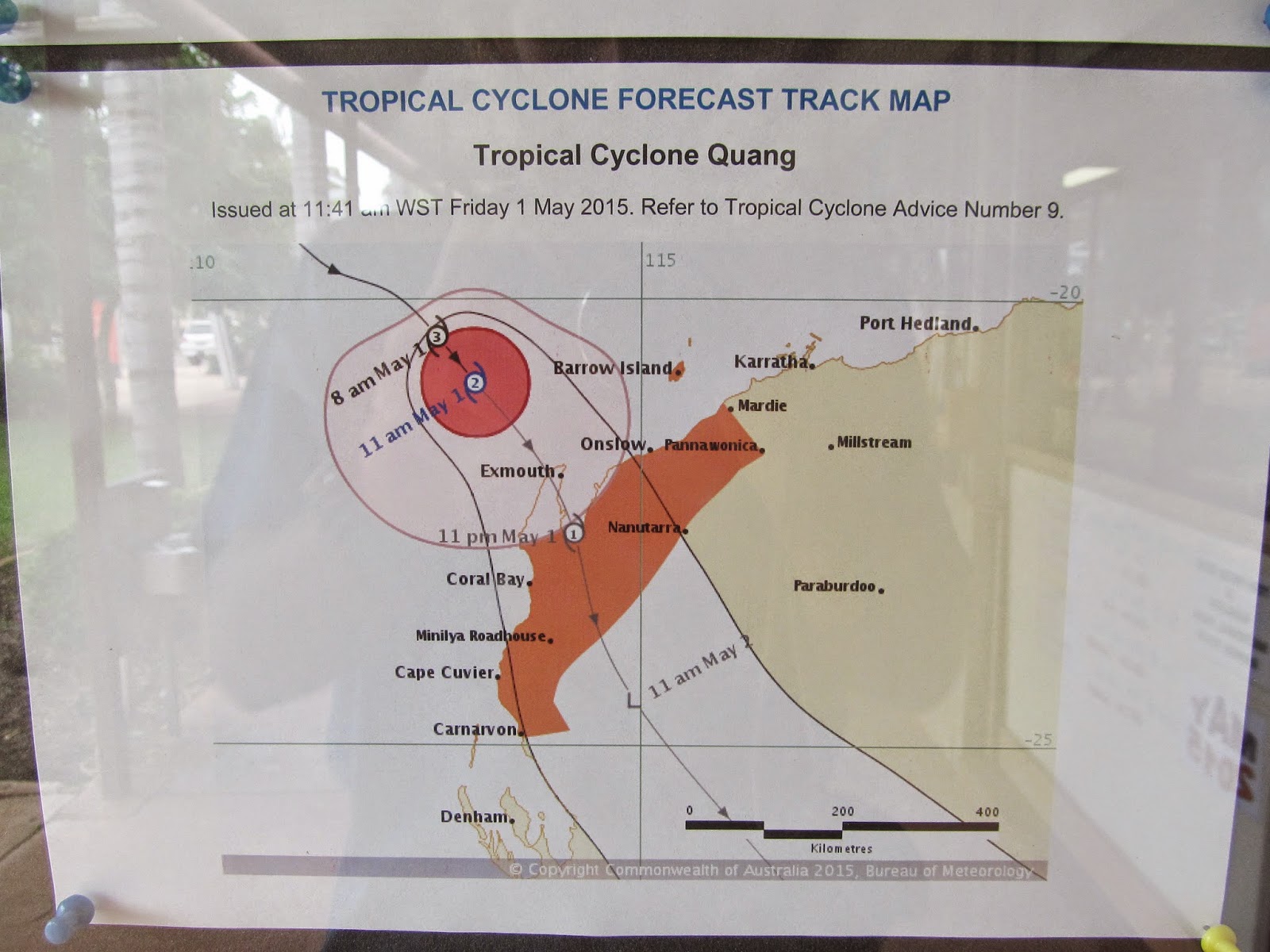
With Tropical Cyclone Quang bearing down on Exmouth we started to travel inland to Tom Price (Rio Tinto Mining Town) and then onto Karijini National Park.


The trip of 570 km was interesting, entering into Hamersley Ranges and the heart of the Pilbura. The earth turns a deep red colour and rocky mountains dominate the landscape (reminded us of some of the trips we did across the US). The last 50km was on unsealed roads and gave us our first taste of corrugations, windrows and red dust (car and camper handled it very well).


The town of Tom Price is small and has a great community feel about it. The town is relatively new and was built by Hamersley Iron to support the Iron Ore mines in the region (a total of 15 mines). Originally it was purely a mining town and you could only live there if you worked in the mines. However, in the 90's the town was sold to the Shire of Ashburton for the price of $1.

We spent our first morning just hanging out in town, the kids visiting the skate park on their scooters, the visitors centre and the library.

In the afternoon we hiked up Mt Nameless (Jarndrunmunhna) which overlooks the town. Reaching the summit is "hard yakka" (that's us having just got to the top) but rewards you with spectacular views over the Hamersley Ranges and the Tom Price town and mine site.


The next day Nath and I went on a tour of the Tom Price Mine which was amazing.


The shear size and scope of the mine is hard to convey but here are a couple of facts that Nath jotted down and incorporated in his journal:

Tom Price Mine:
- Mine site 14km x 8km
- Annual Production 290 million tonnes of Iron Ore.
- Annual Diesel Consumption: 12 million litres.

Kamatsu Haul Trucks:
- 11.8m long, 7.0m wide, 5.7m high.
- Cost $4.5 million each.
- 240 tonne carrying capacity.
- 16 cylinder turbocharged diesel engine generating 2500 hp at approx. 2100RPM.
- Fluid Capacities:
  - 151 litres of engine oil.
  - 303 litres of engine coolant.
  - 4920 litres of diesel fuel.
- 1 tyre weighs 3 tonnes and costs $31,000 (there are 6 on each truck).

Amazing stuff (well, Nath and I think so!).


After the mine tour we left Tom Price and headed for our next stop... Karijini National Park.


Travel Log:
Exmouth to Tom Price: 571 km
Total Trip: 7150 km

Thursday, 30 April 2015

Exmouth & Whale Sharks (By Simon)

After loving every minute of Cape Range National Park we sadly packed up camp and headed back into civilization. Our plan was to have a few quiet days in Exmouth getting ready for the next leg of our trip and go on our highly anticipated swim with the whale sharks (Nath had been counting down the days and researching the tour from long before we left home!).

Our first day in Exmouth consisted of food shopping, clothes washing, oil & filter change on the cruiser, etc. By late afternoon we were ready for something else so we headed out to Bengai Pier for a spot of fishing. It wasn't long before we had a couple of rods in the water and catching fish. We caught so many fish of different kinds that we lost count. And all put up a good fight with our rods almost doubled over, the kids were delighted! Unfortunately, it was Dad who had to retrieve hooks and set the bait!


Unfortunately Western Australia's fishing is so good that their size limits are huge... even the 40cm Cod that Nath caught was undersize. Regardless, we all had a great time.

We also explored the canyons on the east side of Cape Range National Park.


Ningaloo Blue Whale Shark Tour:
Our tour day had finally arrived and we were picked up at our caravan park at 7:15am for the short trip to the boat harbour where we boarded Ningaloo Blue's Venture III.

After a short trip to the outer reef we all jumped in for a snorkel around the reef which was very different to the inner reefs we had been exploring up to this point. The water was a lot deeper but so clear and the marine life amazing (thousands of fish, sting rays, turtles and even a small reef shark).


Only a minute or so after we had climbed back on board we were told to get ready to jump back in as our first whale shark had been spotted and was only 50m away. You could feel the excitement (and nerves) on the boat jump up a notch! In no time we were back in the water and peering into the depths looking for the approaching giant. It was an eerie feeling, not quite knowing what to expect and just then a whale shark the size of a bus gracefully glides into view. The word "awesome" is used willy-nilly these days but it is the best word to describe the experience... it was truly awe-inspiring!


I was a little concerned that the kids, one, may have been too scared to snorkel with a whale shark and two, not be able to swim fast enough to keep up. But I needn't have worried on either count. They all did great! The shark slowly swims along, not the least worried about 10 excited humans frantically flapping along side. Nath, Sarah and Emma were all able to get within 3m of the shark and swim along side for some time (see picture of Nath below).


This was an amazing day and we are apparently now included in the 0.1% of the world's population that has swum with a whale shark (truly blessed). We could not have asked for a more perfect day. As Nath wrote in his journal that night "you should definitely try this if you get the chance"!